Heim Colloquium 2026: “Who owns translations? On Literary Rights and Cultural Ownership”
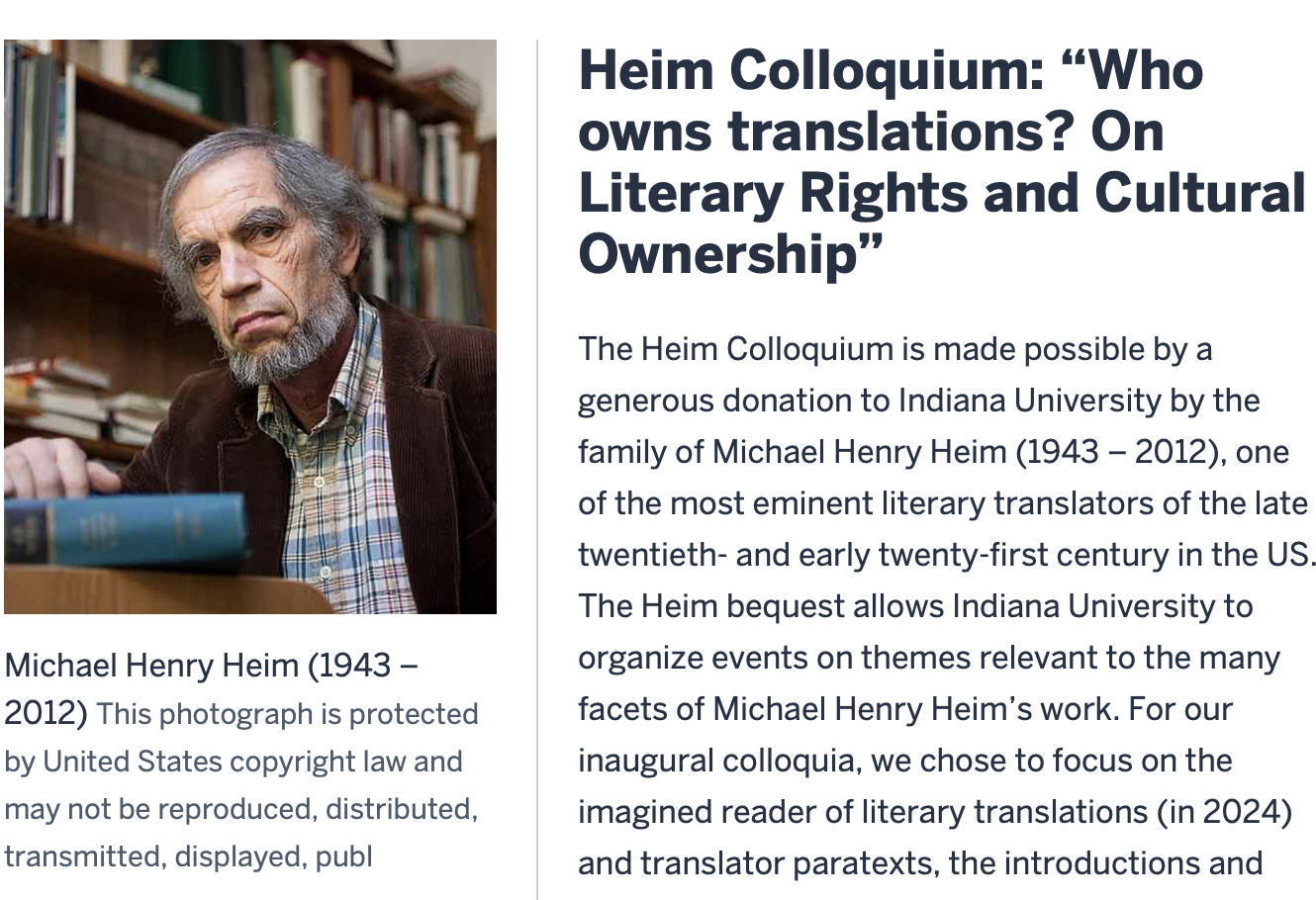
Description
The Heim Colloquium is made possible by a generous donation to Indiana University by the family of Michael Henry Heim (1943 – 2012), one of the most eminent literary translators of the late twentieth- and early twenty-first century in the US.The Heim bequest allows Indiana University to organize events on themes relevant to the many facets of Michael Henry Heim’s work. For our inaugural colloquia, we chose to focus on the imagined reader of literary translations (in 2024) and translator paratexts, the introductions and afterwords translators have written about their work (in 2025). For this year’s event, we invited a core group of translation-focused graduate students at IU Bloomington to take the lead in forming the questions to be addressed and inviting a panel of experts to help us address them.
The title of this year’s colloquium is “Who Owns Translation?” Who owns translations? Is it the translator? The author of the source text? The publisher? The “foundation” and other estates that control the rights? Our colloquium explores the question of ownership from theoretical, practical, and speculative perspectives. First, what are some ways that the translator conceptually “owns” the translation? At issue are questions of how translators make choices that redistribute narrative authority, how they develop a responsibility for the work of another, and whether certain texts “invite” co-ownership while others do not.
We would also like to explore how the literary market shapes questions of ownership. How does the contemporary culture of self-promotion and social media play a role in this ownership? What are some cultural imbalances that exist when translating from minor languages and/or niche subcultures into the dominant language and/or literary market? Additionally, what practical considerations do translators have when obtaining rights of the source text and negotiating control over their translations? What institutional and legal barriers must one navigate? Are there creative loopholes to work around copyright and other regulations regarding translation?
Finally, we want to offer a space for imagination. What would an ideal version of literary copyright look like?
Participants
Esther Allen is a professor in the Ph.D. Programs in French, Comparative Literature, and Latin America, Iberian and Latino Cultures (LAILaC) at the City University of New York Graduate Center. Her translation of the Trilogy of Expectation by Antonio Di Benedetto (Zama, The Silentiary, and The Suicides) was supported by a grant from the Guggenheim Foundation and Zama was awarded the National Translation Award by ALTA. She has been a Fellow at the Center for Scholars and Writers at the New York Public Library and was named a Chevalier de l’Ordre des arts et des lettres by the French government. Her essays and translations have appeared in The New York Review of Books, The LA Review of Books, Words Without Borders, The Paris Review, The Poetry Foundation, Nimrod, and other publications. She is currently completing a biography of José Martí.
Stine An is a poet, translator, and performer based in New York City. She holds a BA in Literature from Harvard and an MFA in Literary Arts from Brown, and has received fellowships and grants from The Poetry Project, the PEN/Heim Translation Fund Grant, Yaddo, ALTA, and the National Endowment for the Arts. Her publications include Today’s Morning Vocabulary by Yoo Heekyung (2025), Winter Night Rabbit Worries by Yoo Heekyung (2026), and S_MMER CR_SH (2025). Their debut poetry collection, B-Dragon Suite (2026), won the 2023 Nightboat Poetry Prize and is available from Nightboat Books. You can find her online at gregorspamsa.com.
Soleil Davíd is a poet and translator from the Philippines. She is a National Endowment for the Arts fellow, a winner of the Don Carlos Palanca Memorial Awards for Literature, and has received support from both the Bread Loaf Writers’ and Translators’ Conferences, MacDowell, and the DC Commission on the Arts and Humanities, among others. Her translation of Carlo Paulo Pacolor’s short story collection The Compendium of Impossible Objectsis forthcoming from Tilted Axis Press.
Rachel Cordasco founded the website SFinTranslation.com in 2016 and regularly reviews speculative fiction in translation for Strange Horizons and other magazines. Her translations from the Italian of Clelia Farris’s science fiction have been published in Clarkesworld Magazine, Future Science Fiction Digest, and elsewhere. Rachel’s books on SFT are Out of This World: Speculative Fiction in Translation From the Cold War to the New Millennium (University of Illinois Press) and Speculative Fiction in Translation From Around the World (University of Wales Press).
Mordecai Martin is a 5th generation New Yorker, a writer, and a translator of Yiddish and Hebrew poetry, prose, and scripture. He is a 2026-2027 Translation Fellow at the Yiddish Book Center in Amherst, MA and holds an MFA from Randolph College. His translation work can be seen in literary journals such as Exchanges, Turkoslavia, ANMLY, and Asymptote. He lives in Mexico City with his wife, child and Pharaoh-Let-My People-Go the cat.